


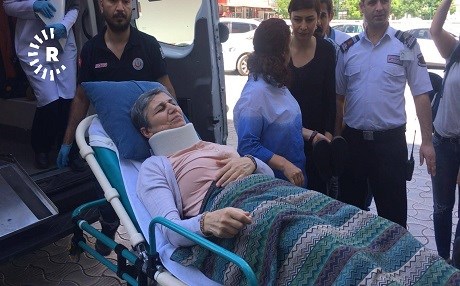
ERBIL, Kurdistan Region — Two hundred days of hunger strikes led by pro-Kurdish Democratic Peoples’ Party (HDP) MP Leyla Guven and some 3,000 others protesting state authority ended on Sunday following repeated requests to do so by jailed Kurdistan Workers’ Party (PKK) leader Abdullah Ocalan.
Guven was taken to Memorial Hospital in Diyarbakir (Amed) by ambulance while stating the protesters had “achieved their goal” of “ending the isolation” of Ocalan who had no access to legal counsel in eight years until earlier this month. He has been allowed sporadic access to family members during holidays.
She began the hunger strike in November 2018 in jail, but was released to her home in February 2019 due to deteriorating health. Guven was eventually joined by three other party MPs and some 3,000 others globally, demanding regular access to Ocalan by his lawyers and family.
Earlier on Sunday, lawyers from Ocalan’s team had read a statement in Istanbul from Ocalan who encouraged for the hunger strikes to end.
“Comrades who have committed themselves to hunger strikes and death fasts, I expect you to end your protest,” the statement read. It was read aloud four days after lawyers visited Ocalan for the second time this month.
There is hope the moves could revive peace talks between the PKK and the Turkish state which stalled following a lull in armed contact from 2013-2015. Ocalan was part-and-parcel to the peace process while imprisoned at Imrali Island in the Marmara Sea, where he has been held since 1999.
This was seemingly reinforced by one of Ocalan's lawyer's, Newroz Uysal, who Al Jazeera quoted as saying that Ankara’s acquiescence to legal counsel did not necessarily mean negotiations. Despite this, Ocalan has said he was ready to play a positive role on issues concerning Syria.
Guven does not view the achievements of the hunger strike as absolute. She said in the HDP statement that it had "opened a door" for Ocalan to receive visits, but that hunger strikers "will continue our active struggle in different ways to completely eliminate the isolation.”
The position mirrors that of the Kurdistan Communities Group (KCK), a banned Kurdish political party group that many in the HDP have sought to distance itself from.
Guven described Ocalan as the "only interlocutor for an honorable peace to end the suffering experienced on our lands".
In the statement earlier this month, Ocalan discouraged armed struggle. He instead called for the resolution of "the issues of Turkey – and even the region – through soft power. I mean intellectual, political, and cultural powers – not through physical violence.”
Beyond events in Turkey, he called on the Kurdish-led Syrian Democratic Forces (SDF) to stay away from "the culture of conflict" and for the respect of Syria's "territorial integrity".
Guven was taken to Memorial Hospital in Diyarbakir (Amed) by ambulance while stating the protesters had “achieved their goal” of “ending the isolation” of Ocalan who had no access to legal counsel in eight years until earlier this month. He has been allowed sporadic access to family members during holidays.
She began the hunger strike in November 2018 in jail, but was released to her home in February 2019 due to deteriorating health. Guven was eventually joined by three other party MPs and some 3,000 others globally, demanding regular access to Ocalan by his lawyers and family.
Earlier on Sunday, lawyers from Ocalan’s team had read a statement in Istanbul from Ocalan who encouraged for the hunger strikes to end.
“Comrades who have committed themselves to hunger strikes and death fasts, I expect you to end your protest,” the statement read. It was read aloud four days after lawyers visited Ocalan for the second time this month.
Ocalan’s first visit in May from his lawyers came on May 2. They were the first visits he had received from lawyers since 2011, with their visits previously having been refused a reported 810 times.
There is hope the moves could revive peace talks between the PKK and the Turkish state which stalled following a lull in armed contact from 2013-2015. Ocalan was part-and-parcel to the peace process while imprisoned at Imrali Island in the Marmara Sea, where he has been held since 1999.
The deal's collapse led to some of the worst violence of the four-decade conflict, while also emboldening Recep Tayyip Erdogan, now the country’s president, who seems to consider the prospect of peace in the near future. At least 4,356 people have been killed in clashes or attacks on both sides since July 20, 2015, according to the International Crisis Group (ICG).
Turkey's Justice Minister Abdulhamit Gul denied any link between the easing of Ocalan's isolation and a potential resumption of the peace process when he spoke to journalists on Thursday.
This was seemingly reinforced by one of Ocalan's lawyer's, Newroz Uysal, who Al Jazeera quoted as saying that Ankara’s acquiescence to legal counsel did not necessarily mean negotiations. Despite this, Ocalan has said he was ready to play a positive role on issues concerning Syria.
Gul has also denied any connection to the re-run of the Istanbul mayoral election scheduled for June. Erdogan's Justice and Development Party (AKP) narrowly lost to the country’s largest opposition party, the Republican People’s Party (CHP). HDP and Kurdish voters could potentially decide the outcome.
Guven does not view the achievements of the hunger strike as absolute. She said in the HDP statement that it had "opened a door" for Ocalan to receive visits, but that hunger strikers "will continue our active struggle in different ways to completely eliminate the isolation.”
The position mirrors that of the Kurdistan Communities Group (KCK), a banned Kurdish political party group that many in the HDP have sought to distance itself from.
Guven described Ocalan as the "only interlocutor for an honorable peace to end the suffering experienced on our lands".
In the statement earlier this month, Ocalan discouraged armed struggle. He instead called for the resolution of "the issues of Turkey – and even the region – through soft power. I mean intellectual, political, and cultural powers – not through physical violence.”
Beyond events in Turkey, he called on the Kurdish-led Syrian Democratic Forces (SDF) to stay away from "the culture of conflict" and for the respect of Syria's "territorial integrity".
Ocalan and the PKK's influence flows beyond Turkish borders. The People’s Protection Units (YPG), part of the multi-ethnic Syrian Democratic Forces (SDF) umbrella controls about 30 percent of Syria after liberating it from the Islamic State (ISIS) with the support of the US-led international coalition. The SDF deny any organic links to the PKK, but have clear ideological similarities.
Clashes between the PKK and Turkey recently have spiked the Kurdistan Region of Iraq — where the group has outposts and its headquarters in the mountainous border region of Qandil.
The PKK, co-founded and led by Ocalan since 1978, began its armed insurgency against the Turkish state in 1984, in search of improved minority, cultural, and political rights in Turkey. The decades-long conflict has resulted in a death toll of 30,000-40,000, according to ICG statistics.
Expectations that the end of hunger strikes could be a precursor to a renewed PKK-Turkey peace process have been fueled partly due to Ocalan’s call in 2012 to end a hunger strike by prisoners taking place at the time — a month later, it emerged that he was in negotiations with Ankara for peace.
Comments
Rudaw moderates all comments submitted on our website. We welcome comments which are relevant to the article and encourage further discussion about the issues that matter to you. We also welcome constructive criticism about Rudaw.
To be approved for publication, however, your comments must meet our community guidelines.
We will not tolerate the following: profanity, threats, personal attacks, vulgarity, abuse (such as sexism, racism, homophobia or xenophobia), or commercial or personal promotion.
Comments that do not meet our guidelines will be rejected. Comments are not edited – they are either approved or rejected.
Post a comment